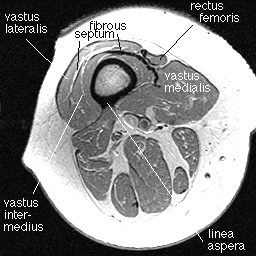

Note the linea aspera, a ridge running down the posterior margin of the femur. The linea aspera is a popular muscular insertion site. In this image one can see the vastus intermedius and vastus lateralis inserting there, and the short head of the biceps femoris originating there.
As one travels distally down the thigh, the vastus lateralis and vastus medialis insert on the quadriceps tendon, as well as along the lateral and medial margins of the patella, helping to form the lateral and medial fibrous retinaculum around the patella.
Now, use the movie view of the thigh to follow these muscles up and down the legs.
If you have not already downloaded the movie, click here to do so.
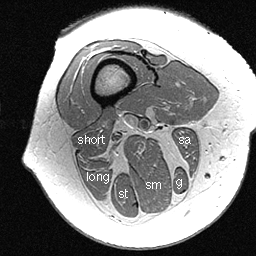
The semitendinosus (st) runs medially and attaches along the tibial tuberosity. It derives its name from its anatomy: in its distal 1/3 to 1/2, the muscle gives way to very long and slender tendon, which attaches distally on the tibial tuberosity. Orthopedic surgeons often take advantage of this peculiar anatomy and use part of the distal tendon to reconstruct a torn anterior cruciate ligament.
The gracilis (g) (means slender or delicate in Latin) also runs from the ischial tuberosity to the tibial tuberosity. The sartorius (sa), runs from the anterior superior iliac spine down to the tibial tuberosity. Sartor is Latin for tailor, and the sartorius is sometimes referred to as the tailors muscle. This may be because the sartorius acts to flex the hip and knee and laterally rotate the hip, just the thing for sitting cross-legged and sewing a garment.
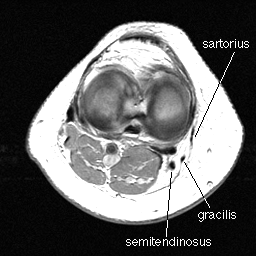
The distal tendons of the sartorius, gracilis and semitendinosus pass medial to the medial collateral ligament on their way to the tibial tuberosity. These three tendons are collectively known as the pes anserinus (Latin for foot of the goose), because of their shape. A bursa lies between these three tendons and the MCL, known, oddly enough, as the anserine bursa. Occasionally, one can see a fluid collection in this bursa due to anserine bursitis. This should not be mistaken for a popliteal cyst, which occurs more posteriorly, between the tendon of the medial head of the gastrocnemius and the semimembranosus tendon.
Now look at the distal thigh again, in the movie that you have already downloaded. Try to follow these muscles and their tendons up and down the thigh.
Now, we just need to discuss a few more muscles to collect the whole set. First, look at the plantaris muscle in the image below. This is not a major muscle in humans or other primates, but is large in other mammals. It lies just under the lateral head of the gastrocnemius, and it helps the gastrocnemius flex the ankle and the knee.
The popliteus is a short, flat muscle that helps to build part of the floor of the popliteal fossa. Its main significance lies not in its muscular action (medial rotation of the knee) but in its sometimes bewildering appearance on knee arthrography. Occasionally, it comes in handy in patients with tumors of the proximal tibia, forming a barrier between tumor and the popliteal neurovascular bundle.
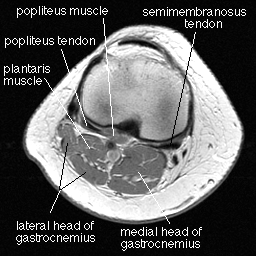
The gastrocnemius muscle is a powerful flexor of the ankle and knee. It originates in two heads arising just above the medial and lateral femoral condyles. Distally, these two heads unite with a broad aponeurosis that extends distally to become the Achilles tendon. The lateral head of the gastrocnemius may contain a small sesamoid bone or cartilage called the fabella (Latin for little bean) in about 29 % of the population. It is ossified in about 10 - 12 % of the population, and should not be mistaken for an intraarticular body.
The semimembranosus originates at the ischial tuberosity and runs down the back of the thigh to attach on a horizontal groove on the posterior surface of the medial condyle of the tibia. It extends the thigh and flexes the knee.
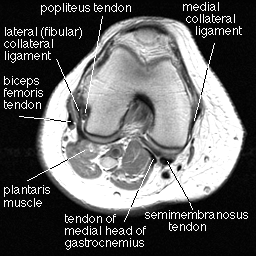
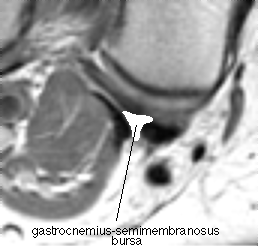
A small bursa lies between the semimembranosus tendon and the tendon of the medial head of the gastrocnemius. This bursa may communicate with the knee joint space. On MR, it appears as a triangular or star-shaped area of intermediate intensity between these tendons. The gap between these tendons is a potential weak spot, and fluid may herniate between them, forming a popliteal cyst (Bakers cyst). A joint effusion is almost always seen with a popliteal cyst.
Now, go back to the movie that you downloaded for one last review of all of the anatomy that you have learned in this module.
Click here to return to list of Anatomy Modules.
Michael L. Richardson, M.D. (mrich@u.washington.edu)